Financial Assistance
The 7-Minute Charity Care Application Most Patients Never Use
By BillBusted • Published May 6, 2026 • 9 min read
Federal law requires every nonprofit hospital to offer a financial assistance program. Most patients facing large bills never apply — because no one tells them the program exists or explains how to fill it out. Here is how to do it in about seven minutes.
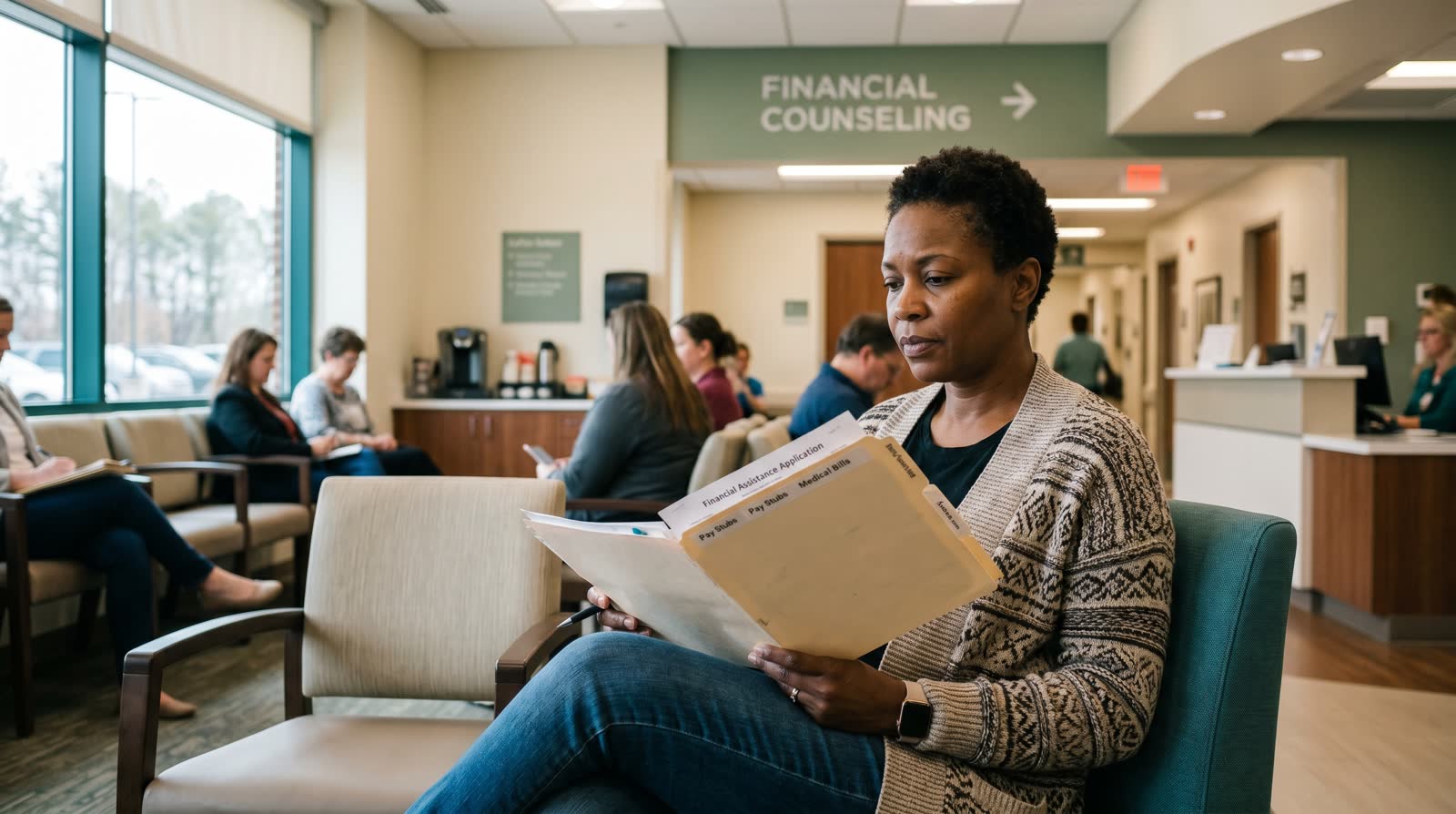
What 501(r) Actually Requires Nonprofit Hospitals to Do
Section 501(r) of the Internal Revenue Code sets the conditions under which a hospital qualifies for nonprofit, tax-exempt status. To keep that exemption, a hospital must meet four community benefit requirements. The most important one for patients is the financial assistance policy (FAP) requirement.
Under 501(r), every nonprofit hospital must:
- Maintain a written financial assistance policy that is publicly available
- Widely publicize the policy to patients (including on billing statements)
- Limit amounts charged to FAP-eligible patients — not charge them more than the amounts generally billed to insured patients
- Not engage in extraordinary collection actions (lawsuits, liens, wage garnishment) against a patient without first making reasonable efforts to determine whether they qualify for financial assistance
That last point matters. If you have a large hospital bill and have not applied for financial assistance, the hospital legally cannot sue you or report the debt to credit agencies without first giving you a reasonable opportunity to apply. That window is at least 240 days from the first billing statement.
This isn't charity in the feel-good sense — it's a federal requirement in exchange for the hospital's tax-exempt status. You are not asking for a favor. You are using a program the hospital is required by law to offer.
To understand the scale of why this matters: the CFPB has noted that up to 49% of medical bills contain at least one error — meaning the total you're looking at may already be inflated before the financial assistance conversation even starts. JAMA Health Forum found that 74% of patients who formally dispute or seek a reduction on a bill receive one. Applying for financial assistance is one of the most direct ways to be in that 74%.
Who Qualifies — Income Thresholds Explained
Eligibility for charity care is generally based on income relative to the Federal Poverty Level (FPL). The IRS does not set a single income cutoff for 501(r) purposes, but most nonprofit hospitals offer:
- Free care for patients below 200% FPL (approximately $31,200 per year for a single person in 2026)
- Discounted sliding-scale care for patients between 200% and 300–400% FPL
Some larger academic medical centers and hospital systems extend eligibility much further. It is not uncommon to see sliding-scale discounts for patients earning up to 500% FPL — which for a family of four in 2026 is approximately $162,500 per year.
The key: every hospital's policy is different. The only way to know for certain whether you qualify is to ask for and read the hospital's specific financial assistance policy before assuming you don't qualify.
Income is not the only factor
Some hospitals also consider:
- Household size (more dependents increases the effective FPL ceiling)
- Medical expenses as a percentage of income (a catastrophic bill may qualify even at a higher income)
- Extraordinary circumstances (job loss, recent illness, disability)
If your income is borderline, apply anyway and explain the circumstances in writing. Denials can be appealed, but an unsubmitted application cannot.
How to Apply: The 7-Minute Process
Here is the actual application process, step by step. Once you have your documents assembled, the form itself typically takes 5 to 10 minutes.
Step 1: Find the hospital's financial assistance policy (2 minutes)
Call the hospital's main billing line and ask specifically: "Can you send me the financial assistance application and your financial assistance policy?" Alternatively, most nonprofit hospitals are now required to post the policy on their website. Search the hospital's website for "financial assistance," "charity care," or "patient assistance." If you can't find it, call and ask — they are required to provide it.
Step 2: Read the income thresholds before filling anything out (1 minute)
Before spending time on the form, check the income thresholds in the policy document. Find your household size and compare it to the 200% FPL line. If you're clearly above 400% FPL with no exceptional circumstances, you may want to ask the hospital directly about your options rather than filling out the standard form — some hospitals have hardship programs separate from the standard FAP.
Step 3: Fill out the application form (3–5 minutes)
Most charity care applications ask for:
- Your name, date of birth, and account number (from the bill)
- Household size (how many people live in your home and depend on your income)
- Annual household income from all sources
- A brief explanation of financial hardship (optional on some forms, but useful)
- Your signature confirming the information is accurate
That is genuinely the whole form in most cases. Some hospitals have a longer version asking for employment status, insurance information, and whether you have applied for Medicaid — but they are still typically one to two pages.
Step 4: Submit with documentation (same day or next day)
Most hospitals accept applications by mail, fax, in-person at the billing office, or online. Submit the form and your income documentation together so the review isn't delayed by a missing document request.
Free tool + Full Audit
BillBusted checks your charity care eligibility automatically
The Full Audit ($49) includes a charity care eligibility check based on your income, household size, and the hospital's published FAP thresholds — plus the exact language to use in your application and a reconsideration letter if you're denied.
Start with a free scan See Full AuditNo account required for the free scan.
Documents You'll Need (and Ones You Won't)
Documents you typically need
- Proof of income: the last two or three pay stubs, a recent W-2, or your most recent federal tax return. If you're self-employed, a simple income statement works. If you have no income, a statement to that effect signed by you is usually acceptable.
- Hospital account number: this is on your billing statement. It tells the financial assistance team which bill(s) the application covers.
- Household size documentation: usually just your own statement. Some hospitals ask for a copy of a recent tax return that lists dependents.
Documents you typically do NOT need
- Bank statements (some hospitals ask, but it's not universal — provide only what the form specifically requests)
- Home equity or retirement account valuations (most FAPs focus on income, not assets)
- Documentation of every household expense
If a hospital asks for documentation that feels excessive — for example, full bank statements going back a year — you can ask whether a simpler income verification will suffice. In most cases it will.
What Happens After You Apply
Under 501(r), the hospital must make a determination on your application. While the application is under review, the hospital should suspend any collection activity. Do not make partial payments while the application is pending unless the hospital specifically advises you to — partial payments can sometimes be interpreted as accepting the full bill.
Processing time varies: smaller hospitals may respond in a week; larger systems can take 30 to 45 days. If you haven't heard back in two weeks, call and ask for a status update. Keep a record of who you spoke with and when.
If approved
The hospital will send you a written determination stating the discount or elimination of charges. Get this in writing and keep it. Follow up within a week to confirm the adjustment appears on your account. Request an updated statement showing the new balance.
If partially approved
Some hospitals approve a sliding-scale discount rather than full elimination. That discounted balance is what you then owe. If the remaining balance is still unmanageable, ask the billing department about an interest-free payment plan — which 501(r) also requires hospitals to offer to FAP-eligible patients.
Can Insured Patients Apply for Charity Care?
Yes. This surprises many people. Having insurance does not disqualify you from financial assistance. Most hospitals apply charity care to the patient-responsibility portion — the amount left after your insurer has paid its share.
If you have a $10,000 hospital bill, your insurer paid $6,500, and your out-of-pocket responsibility is $3,500 — that $3,500 can potentially be reduced or eliminated through the hospital's financial assistance program, assuming your income qualifies.
AARP research found the average overcharge on hospital bills over $10,000 runs approximately $1,300 — meaning the patient-responsibility amount may already be inflated before any charity care adjustment. Running a free BillBusted scan before applying can help you confirm you're starting from the right baseline number.
Also review whether you have any EOB discrepancies — compare the EOB patient responsibility to the amount on the provider bill before submitting a charity care application, so you're applying to reduce the right number. Our EOB reading guide walks through this step by step.
What to Do If You're Denied
Ask for the denial reason in writing
The hospital is required to tell you why your application was denied. If it's an income-threshold issue, ask whether there is a hardship exception or a separate program you might qualify for.
File a reconsideration
Most hospitals allow a reconsideration within 30 to 60 days of the denial. Write a brief letter (one page is enough) that restates your income, your household circumstances, the amount of the bill relative to your income, and any exceptional circumstances. Request that the billing department director or a patient advocate review the file.
Contact your state attorney general or hospital association
Many states have enacted charity care laws that supplement or expand the federal 501(r) requirements. Your state attorney general's consumer protection division or the state hospital association's patient advocacy office can sometimes intervene when a qualified patient is being denied benefits they're entitled to.
Flag collection activity immediately
If the hospital initiates collection actions while your application or reconsideration is pending, that may be a 501(r) violation. Contact the hospital's compliance officer in writing and note that collection activity is improper while a financial assistance determination is pending. Keep copies of everything.
Frequently Asked Questions
Does every hospital have to offer charity care?
Not every hospital is required to offer charity care. Only nonprofit hospitals with 501(c)(3) tax-exempt status must maintain a financial assistance program under IRS Section 501(r). For-profit hospitals may offer it voluntarily, and some states require all hospitals to provide charity care regardless of tax status. Up to 49% of medical bills contain at least one error (CFPB, 2023), so checking eligibility at a nonprofit hospital before paying is a practical first step.
What income level qualifies for hospital charity care?
Income thresholds for charity care vary by hospital. Under IRS 501(r) rules, nonprofit hospitals must provide free or discounted care to patients below 200% of the Federal Poverty Level, and many extend sliding-scale discounts up to 400% FPL or higher. For 2026, 200% FPL for a family of four is approximately 5,000 per year. The average overcharge on bills above 0,000 is roughly ,300 (AARP, 2024), making a charity care application worth the effort for most large bills.
Can I apply for charity care after my bill has gone to collections?
You can still apply for charity care after a bill has gone to collections. Under IRS 501(r), nonprofit hospitals must accept financial assistance applications for at least 240 days after the first statement date, even if the account is already with a collection agency. About 73.7% of patients who dispute a medical bill receive a correction (JAMA Health Forum, 2024). The hospital must also pause collection activity while reviewing your application.
What documents do I need for a hospital charity care application?
A typical charity care application asks for proof of income — recent pay stubs, last year's tax return, or a self-employment income statement — and proof of household size. Some hospitals also request recent bank statements. Up to 49% of medical bills contain at least one error (CFPB, 2023), so gathering documents early lets you address billing issues and the assistance application at the same time. You generally do not need to document all assets, just income.
Can I apply for charity care if I have health insurance?
Having health insurance does not disqualify you from charity care. Many nonprofit hospitals apply financial assistance to the patient-responsibility portion of your bill — the amount left after insurance pays. If that remaining amount creates a financial hardship, you are still eligible to apply. About 73.7% of patients who dispute a medical bill receive a correction (JAMA Health Forum, 2024). Submitting the application costs nothing and can significantly reduce what you owe.
What can I do if the hospital denies my charity care application?
If your charity care application is denied, request the denial in writing along with the specific reason. If your income appears to qualify, ask for a formal review or appeal. Your state hospital association or attorney general's office can also intervene. About 73.7% of patients who dispute a medical bill receive a correction (JAMA Health Forum, 2024). BillBusted's Full Audit includes a charity care eligibility check and can help you draft a reconsideration letter.
Have a large hospital bill and not sure if you qualify for financial assistance?
BillBusted's Full Audit checks your charity care eligibility automatically and generates the application language and reconsideration letter you need — based on your actual income and the hospital's published policy.
No account required to start. No legal advice — just your rights, plainly explained.