Understanding Your Bill
Bill says I owe $X. EOB says I owe $Y. Which is right?
By BillBusted • Published May 6, 2026 • 9 min read
Two documents. Two numbers. One very confused patient. Here is the plain-English guide to understanding why your hospital bill and your Explanation of Benefits show different amounts — and exactly what to do about it.
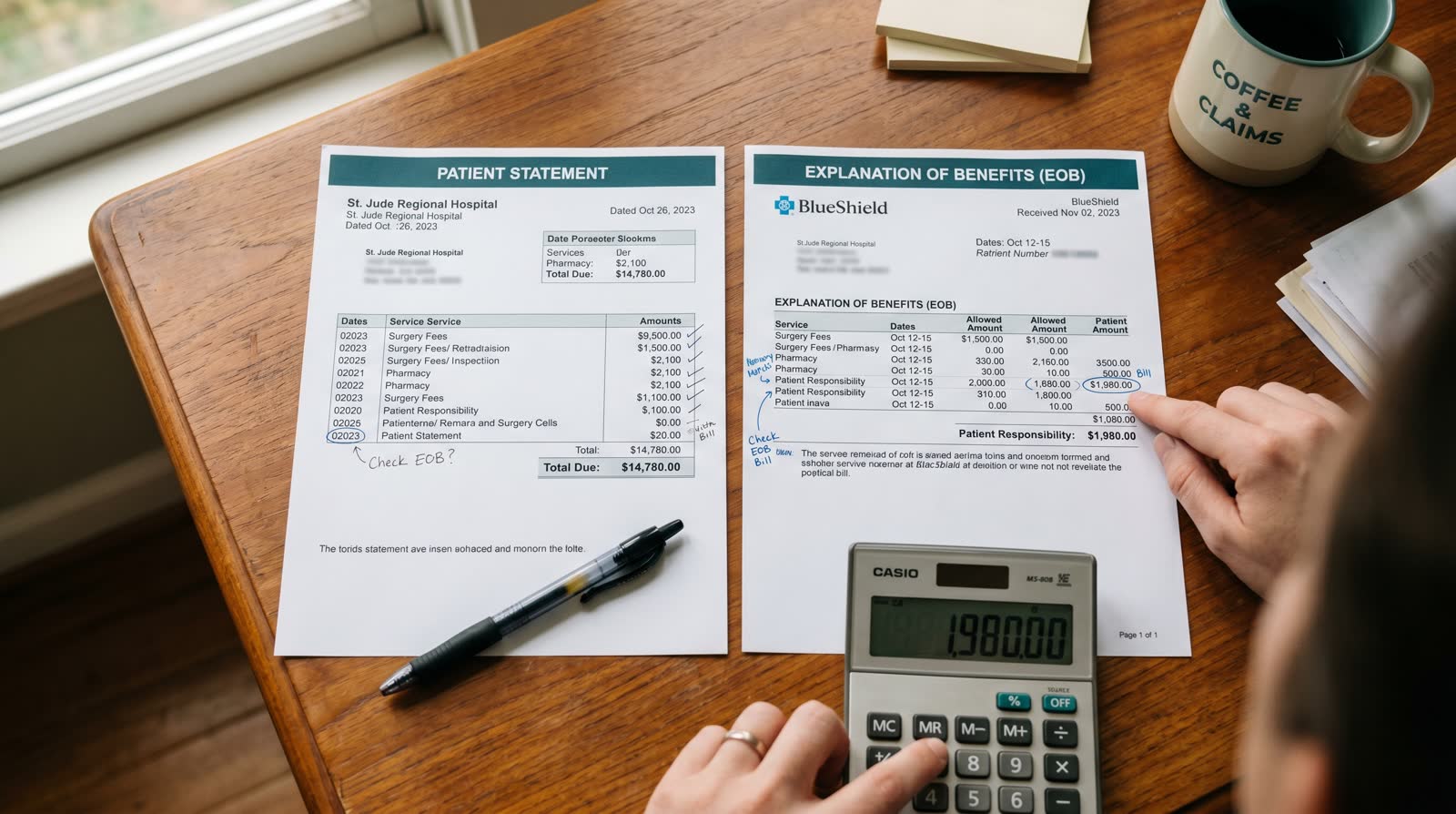
What an EOB actually is (and what it is not)
An Explanation of Benefits is not a bill. Your insurer sends it to you after it processes a claim from a provider. It shows three key figures:
- Amount billed — what the provider asked for.
- Allowed amount — what your insurer has contractually agreed to pay for that service.
- Patient responsibility — what your insurer says you owe, after applying your deductible, copay, and coinsurance.
The EOB is your insurer's official record of how it processed a claim. It is not a demand for payment — that is the provider's separate bill. The confusion arises because these two documents rarely match, for reasons that are not always the provider's fault, but sometimes are.
For a deeper look at the six fields on an EOB that decide whether your bill is correct, see our full guide at BillBusted's Bill vs EOB page.
Why the two numbers almost always differ
Even a perfectly processed, error-free claim will produce two documents with different numbers. That is by design. Here is why:
The provider bills the chargemaster rate
Hospitals maintain an internal price list called a chargemaster. The amount on your patient statement usually starts from the chargemaster rate, which is almost always higher than what any insurer actually pays. Seeing a large gross charge on your statement is normal — what matters is what your insurer's contract says.
The insurer applies a contracted discount
Because your provider is in-network, it has agreed to accept a lower, negotiated rate. The EOB shows this as the "allowed amount" or "negotiated rate." The difference between the chargemaster price and the allowed amount is often called a "contractual adjustment" — money neither you nor your insurer pays.
Timing gaps create apparent discrepancies
Providers often mail patient statements before the insurer has finished processing the claim. If the bill arrives before the EOB, the billed amount will look like your total responsibility — even though most of it will disappear once the insurer processes the claim. Always wait for your EOB before paying a large bill.
Which document controls what you owe
For insured patients whose provider is in-network: the EOB's patient-responsibility line is the authoritative number. Your provider signed a contract with your insurer that prevents it from billing you more than the allowed amount. If the provider's bill exceeds what your EOB says you owe, the excess is generally not collectable from you.
The CFPB found in 2024 that up to 49% of medical bills contain at least one error — meaning a substantial share of the time, the higher number on the provider bill is wrong, not just confusing.
For self-pay patients without insurance, there is no EOB. The bill is the only document, and negotiation or charity-care inquiry is the appropriate next step.
The four most common mismatch types
1. Bill arrived before EOB processing
You receive the provider statement while the insurer is still processing the claim. The bill shows the gross charge; the EOB has not arrived yet. Solution: wait for the EOB and confirm the patient-responsibility line before paying anything.
2. Balance billing by a contracted provider
The provider is in-network but tries to collect the difference between the chargemaster rate and the allowed amount. This is generally a contract violation. The fix is to write to the provider citing your insurer's contract and request a corrected statement.
3. Claim was denied or partially adjudicated
The EOB shows a denial code or a reason code explaining why only part of the claim was paid. This is not necessarily an error — it may reflect a prior-authorization miss, a coordination-of-benefits issue, or a coverage exclusion. Read the reason code carefully and call your insurer if the denial appears incorrect. You can request an internal appeal if you believe the claim should have been covered.
4. Duplicate or miscoded line items
A provider billing system sometimes generates duplicate charges or applies the wrong CPT code. The EOB may show a different code than what appears on your itemized bill, which is one reason requesting an itemized bill is always the right first step. When line-item codes do not match between documents, you have a specific, documentable error to dispute.
Free tool
Upload both documents. Let the AI find the gap.
BillBusted's free Bill Scan accepts your patient bill and your EOB side by side. The AI flags discrepancies, identifies the likely cause, and tells you the single best next step — in plain English, in about two minutes.
Step-by-step: how to reconcile bill vs EOB
Here is a practical five-step process you can complete in an afternoon.
Step 1: Gather both documents
Pull your most recent patient statement from the provider and your EOB from your insurer (check the insurer's member portal if you have not received a paper copy). Make sure both documents relate to the same date of service and the same claim.
Step 2: Match the claim number
Your EOB will show a claim number. Call the provider's billing department and ask them to confirm which claim number corresponds to the bill you received. Mismatched claim numbers are a common source of confusion — two bills for the same visit, or a bill that has already been partially reprocessed.
Step 3: Compare line by line
Ask for an itemized bill if you do not already have one. Match each CPT code on the itemized bill to the corresponding line on the EOB. Note any codes that appear on one document but not the other, and any amounts that differ beyond the expected contractual adjustment.
Step 4: Call your insurer first
If a line item was denied or underpaid, your insurer is the right first call. Ask the representative to walk you through each reason code. If the denial was an error on the insurer's part, ask to open an expedited reprocessing. Get the representative's name, employee ID, and a reference number.
Step 5: Call or write the provider billing department
If the provider's bill exceeds the EOB's patient-responsibility amount, write to the billing department. State the discrepancy clearly, reference the EOB date and patient-responsibility amount, and ask for a corrected statement. Keep copies of all correspondence. You can find a ready-made dispute letter in BillBusted's Resolution Pack ($29).
When the difference is balance billing
Balance billing — where an in-network provider charges you the difference between its chargemaster rate and the insurer's allowed amount — is prohibited under most provider contracts. It is also prohibited by federal law in several situations covered by the No Surprises Act (emergency services, out-of-network providers at in-network facilities, and air ambulance).
If you believe you are being balance-billed by an in-network provider in a non-emergency situation, the dispute path is: (1) write to the provider citing the contract violation, (2) file a complaint with your insurer, and (3) for fully insured plans, file a complaint with your state Department of Insurance. For employer self-funded plans, the complaint route is the Department of Labor's EBSA division.
JAMA Health Forum research found that 74% of patients who dispute a medical bill receive a correction or reduction — which means the effort is worth making even when the process feels intimidating.
Our Surprise Medical Bill Help page covers No Surprises Act balance-billing protections in full detail.
When to escalate and how to get help
Most bill-vs-EOB discrepancies resolve with a single well-documented phone call or letter. When they do not, the escalation path depends on your plan type:
- Fully insured plans (ACA marketplace, small group, individual) — file a complaint with your state Department of Insurance.
- Employer self-funded plans (most large employers) — file a complaint with the Department of Labor EBSA at dol.gov/agencies/ebsa.
- Medicare — file a complaint through the Medicare helpline (1-800-MEDICARE) or the Medicare Ombudsman.
- Medicaid — contact your state Medicaid agency.
For complex situations — where a large balance is at stake, the insurer is unresponsive, or multiple claim denials are involved — BillBusted's Done-For-You service ($149) handles submission, follow-up, and escalation on your behalf. The Full Audit ($49) is a good intermediate step: it adds a deterministic CPT / Medicare-reference benchmark check and a 5-step action plan tailored to your plan type.
You can also use BillBusted's free Bill Scan as a starting point — upload both your bill and your EOB, and the AI will flag the most likely sources of the discrepancy and tell you the single best next step.
FAQ
Common questions about bill vs EOB mismatches
Which document controls what I actually owe — the bill or the EOB?
Your Explanation of Benefits (EOB) controls what you actually owe. The EOB's patient-responsibility line reflects what your insurer has agreed to pay and what your plan says you owe. If the provider bills more than the EOB patient-responsibility amount, that excess is generally not collectible under your plan contract. Up to 49% of medical bills contain at least one error (CFPB, 2023), and a bill-versus-EOB mismatch is one of the most common.
Why does my hospital bill show a higher amount than my EOB?
A hospital bill that exceeds the EOB amount typically happens because the provider billed before the insurer finished processing the claim, the provider is attempting balance billing on a contracted service, there is a data-entry error in the billing system, or the provider applied an outdated fee schedule. Up to 49% of medical bills contain at least one error (CFPB, 2023). Wait for the final EOB, then compare line by line before paying anything.
What if my EOB shows a higher patient responsibility than my actual bill?
When your EOB patient-responsibility amount is higher than the bill you received, the provider has likely applied a prompt-pay discount or adjusted the account before mailing the statement. Up to 49% of medical bills contain at least one error (CFPB, 2023), so the lower bill figure could also reflect a billing adjustment. Contact the provider and ask them to confirm the lower amount in writing before you pay, to protect yourself from a future balance claim.
How long do I have to dispute a bill-vs-EOB discrepancy?
There is no single federal deadline for patients disputing a bill-vs-EOB discrepancy, but most insurers require internal appeals within 180 days of the EOB date. State statutes of limitations on contract claims range from three to ten years, though acting sooner is always better. About 73.7% of patients who dispute a bill receive a correction (JAMA Health Forum, 2024). Aim to file your dispute within 30 to 60 days of receiving the statement to keep the process straightforward.
Can a medical bill go to collections while I am disputing it?
A medical bill can move to collections even while a dispute is in progress, because most providers are not legally required to pause collection activity. Notify the provider in writing that the account is under dispute and keep dated copies. Contact your insurer simultaneously. About 73.7% of patients who dispute a bill receive a correction (JAMA Health Forum, 2024). Written notice creates a paper trail that can help if the account is wrongly reported to a credit bureau.
Does BillBusted automatically compare my bill and EOB?
Yes. When you upload both documents during the free scan, BillBusted's AI identifies line-item discrepancies between your bill and EOB and explains the likely cause of each gap. Up to 49% of medical bills contain at least one error (CFPB, 2023). The Full Audit adds a CPT and Medicare-reference benchmark check and a hospital price-transparency review to help determine whether flagged amounts warrant a formal dispute.
Ready to see what the AI finds?
Upload your bill and EOB together. BillBusted flags the discrepancy, names the likely cause, and gives you the exact language to use when you call billing. Free. No account required.