Patient Rights
How to request an itemized bill from a hospital (with template)
By BillBusted • Published May 6, 2026 • 9 min read
The most powerful thing any patient can do before paying a hospital bill costs nothing and takes less than five minutes. Here is the exact language, the legal right behind it, and what to do with the document once you have it.
What an itemized bill is and why it matters
When you receive care at a hospital, the "patient statement" or "summary bill" that arrives by mail is not the full record of what was charged. It shows a handful of broad categories — "Room and Board," "Medical/Surgical Supplies," "Pharmacy" — with no detail underneath.
An itemized bill is the line-by-line version. Every single service, supply, medication, and procedure the hospital claims it provided is listed separately, each with its own:
- CPT code — the five-digit standardized procedure code.
- Description — plain-English name of the service.
- Date of service — the specific day it was allegedly provided.
- Quantity or units — how many times or units were billed.
- Charge — the amount billed for that line item.
Without the itemized bill, you cannot meaningfully verify whether your hospital bill is correct. The CFPB reported in 2024 that up to 49% of medical bills contain at least one error — and you cannot find those errors in a summary statement. The itemized bill is where errors live, and it is where disputes begin.
AARP research on bills over $10,000 found average overcharges of approximately $1,300 — most of which appear as individual line-item errors rather than gross billing mistakes. Finding them requires the itemized document.
Your legal right to an itemized bill
You have the right to an itemized bill as a patient. This right comes from multiple sources:
CMS Hospital Price Transparency Rule
Effective January 1, 2021, CMS requires all hospitals to post publicly accessible, machine-readable price files. While these are not the same as your personal itemized bill, the regulatory infrastructure supports the requirement that hospitals have and can produce itemized cost data on demand.
IRS 501(r) requirements for nonprofit hospitals
Nonprofit hospitals (which make up the majority of U.S. hospitals) that want to maintain their tax-exempt status under IRS Section 501(r) must have financial assistance policies and must provide plain-language billing communications to patients. This includes the ability to produce an itemized accounting of charges.
State laws
Most states have laws specifically requiring hospitals to provide itemized bills upon patient request. Timeframes range from 10 to 30 days. A number of states — including California and Texas — have statutes explicitly giving patients this right.
Your plan or insurer
Your insurer's EOB already reflects a processed version of the itemized claim submitted by the hospital. You have the right to request the same underlying itemized claim information from your insurer under ERISA and state insurance regulations.
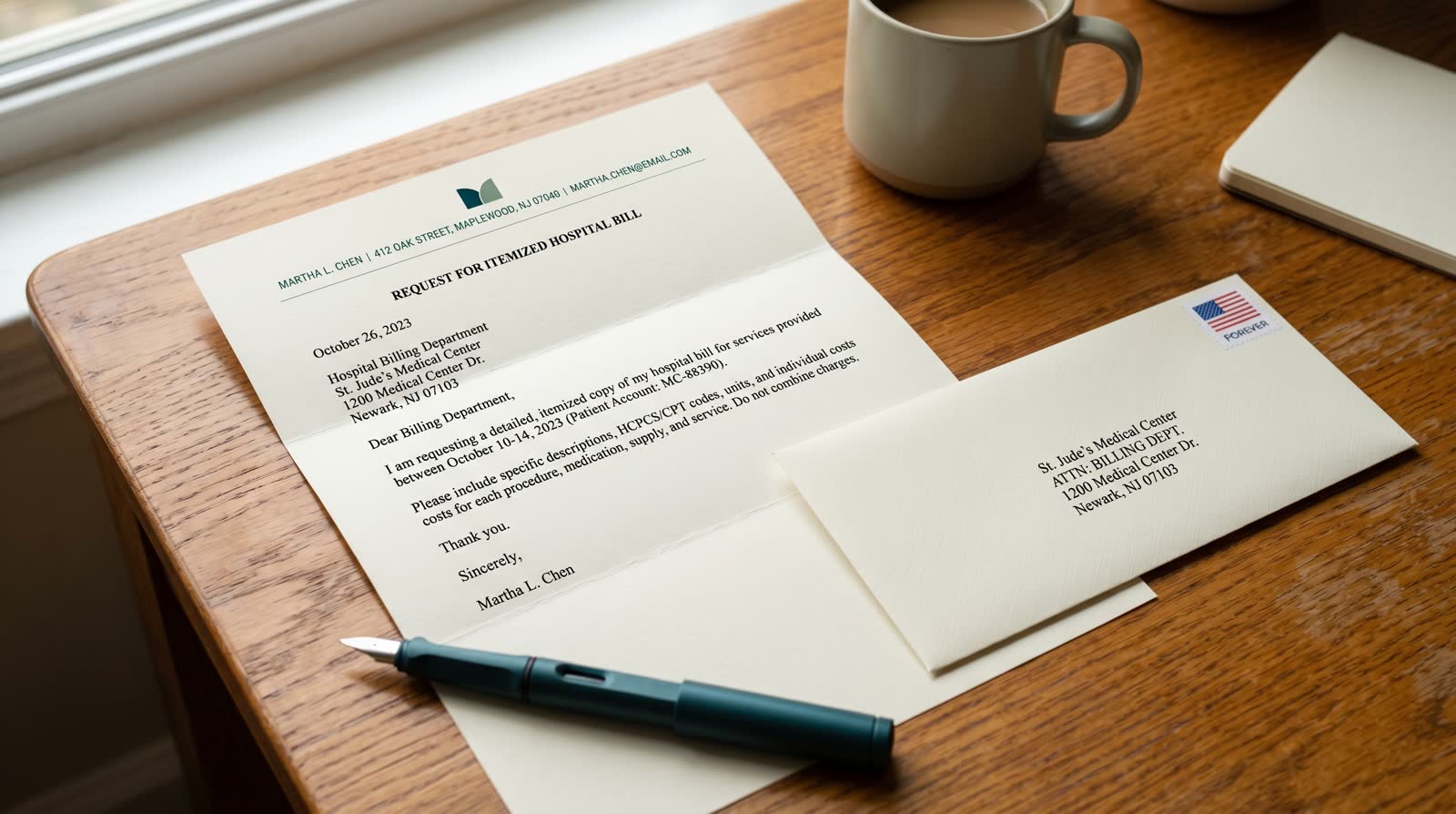
The itemized bill request letter template
Use this template exactly as written. Send by certified mail, return receipt requested, and keep a copy.
You can also access a professionally formatted version of this letter and a ready-to-send dispute follow-up at BillBusted's Itemized Bill Request page.
Free tool
Already have your itemized bill? Upload it and let the AI find the errors.
Once you have your itemized bill, BillBusted's free scan can check it against your EOB, flag duplicate-style charges, identify code questions, and explain what each line item may mean in plain English. The Full Audit ($49) adds a deterministic CPT / Medicare-reference benchmark check and price-transparency checklist so you have more context for reviewing the amounts.
How to send the request (phone vs. letter)
Starting with a phone call
For speed, start with a phone call to the hospital's billing department. Call the number on your patient statement, ask to speak with someone in Patient Financial Services, and request an itemized bill for your account number. Many hospitals will email or mail a PDF within a few days of a verbal request.
The limitation of a phone request: there is no paper trail. If the hospital delays or sends an incomplete document, you have no documentation of your request. Always follow up a phone request with a written confirmation email or letter.
When to go directly to a written request
Send the template letter above immediately if: you are within 30 days of a payment deadline, you plan to dispute the bill, or you have already called and received a summary statement instead of a line-item document. Certified mail creates a legally useful paper trail.
If a hospital refuses or delays
A hospital that refuses to provide an itemized bill, or that takes longer than 30 days without a response, has given you a documentable complaint item. File a complaint with your state hospital licensing authority (typically the state Department of Health) and note the refusal in any subsequent dispute correspondence. For nonprofit hospitals, you can also note the potential 501(r) compliance issue.
What to look for when you get the bill
When the itemized bill arrives, work through it systematically:
Match it to your EOB
If you have insurance, compare each CPT code on the itemized bill to the corresponding line on your Explanation of Benefits. Any code that appears on the bill but not the EOB — or that the EOB shows with a denial code — is worth investigating. Our bill vs EOB mismatch guide explains how to read this comparison.
Check quantities and units
For medications, infusions, and supplies, the quantity matters enormously. A saline bag billed 4 times instead of once, or an infusion session billed for 5 hours when you were there for 2, is a real and common error. Cross-reference dates of service against your own records — your discharge paperwork, your admission date, your own notes from the visit.
Look up unfamiliar CPT codes
You do not need to be a medical coder to check a CPT code. BillBusted's CPT code reference gives plain-English descriptions of the most common codes you will encounter, along with typical Medicare payment benchmarks. If a code on your bill describes a procedure you do not recognize, verify it with your provider before paying.
The six most common errors on itemized bills
These are the patterns BillBusted detects most often across the bills it audits:
1. Duplicate charges
The same CPT code appearing on two different lines for the same date of service, with no clinical reason for the repetition. Common in billing systems that allow easy duplication of entries. See our guide to duplicate hospital charges for how to identify and dispute them.
2. Upcoded procedure codes
A code for a higher-complexity service than what was actually performed. A Level 3 ER visit (CPT 99203) billed as a Level 5 (CPT 99205) is a classic example. The documentation in your medical record should support the code's complexity level — if it does not, you have grounds for a dispute.
3. Unbundled procedures
Several services that are supposed to be billed together under a single bundled code are instead billed as separate line items, each at a higher rate. CMS's National Correct Coding Initiative (NCCI) defines which codes must be bundled. When separate codes appear for services that should be bundled, that is a billing error regardless of whether it was intentional.
4. Charges for services not received
Physical therapy billed for a day you were in surgery. A consultation from a specialist who stopped by but did not actually examine you. These are errors that only a patient can catch — you know what happened during your stay; the billing system does not.
5. Incorrect number of medication units
Pharmacy charges are especially prone to unit errors. Each medication will have a charge per unit (pill, dose, mg, mL). Check whether the number of units billed matches your medication administration records from the hospital — ask for those records separately if you do not have them.
6. Room and board rate errors
The daily room charge should reflect the type of room you occupied (general medical/surgical, ICU, step-down). ICU rates are significantly higher than general ward rates. Verify that the room type on each day of your itemized bill matches where you actually stayed.
What to do after you review the bill
Once you have reviewed the itemized bill and identified one or more errors, the next step depends on the type of error:
Simple billing errors (duplicate charges, wrong units)
Call the billing department, state the error by line number and CPT code, and ask for a corrected statement. Most straightforward errors resolve with a single call when you cite the specific line item. Follow up in writing if the corrected statement does not arrive within 10 days.
Complex errors (upcoding, unbundling, services not received)
Write to the billing department and simultaneously notify your insurer. Cite the specific CPT codes, the dates of service, and the basis for the dispute. BillBusted's Resolution Pack ($29) generates a formal dispute letter, a provider call script, an escalation letter, and a follow-up timeline — all pre-populated for your specific situation.
If the bill is in collections
You still have the right to the itemized bill. Request it from the original provider (the hospital), not the collection agency. Use it to establish whether the debt amount being collected is accurate. See our medical bill collections guide for the full rights framework. JAMA Health Forum research found 74% of patients who dispute a medical bill receive a correction or reduction — and that includes disputes initiated after the bill has gone to collections.
The itemized bill request is always Step 1. Before you dispute, before you pay, before you negotiate — get the line-item document. Everything else follows from it.
FAQ
Common questions about requesting an itemized bill
Do patients have a legal right to request an itemized hospital bill?
Every patient is legally entitled to an itemized hospital bill. CMS requires hospitals to publish price information, and 501(r) nonprofit hospitals must provide itemized statements on request. State laws add independent protections in most cases. Up to 49% of medical bills contain at least one error (CFPB, 2023), which is exactly why reviewing an itemized bill line by line before paying is one of the most effective steps a patient can take.
What is a CPT code and why does it matter on a hospital bill?
A CPT code is a standardized five-digit number that identifies every procedure, service, and supply billed in a medical encounter. When your itemized bill lists CPT codes, you can verify what was charged, look up standard pricing, and compare against your Explanation of Benefits. Up to 49% of medical bills contain at least one error (CFPB, 2023), and CPT mismatches are one of the most common sources of those errors.
How long does a hospital have to respond to an itemized bill request?
There is no single federal deadline for providing an itemized bill, but most hospitals deliver one within 7 to 30 days. Many states specify 10 to 15 business days by law. Up to 49% of medical bills contain at least one error (CFPB, 2023), so time matters when you are trying to dispute before a balance goes to collections. If a hospital does not respond within 30 days, follow up in writing and document your request.
Can a hospital charge a fee to provide an itemized bill?
Most hospitals provide itemized bills at no charge, and many states prohibit fees for them entirely. If you are asked to pay for an itemized statement, note the request in writing and check your state law before agreeing. Up to 49% of medical bills contain at least one error (CFPB, 2023), and your ability to catch those errors depends on getting the itemized record. Do not let a potential fee discourage you from requesting one.
What are the most common errors to look for on an itemized hospital bill?
The most common itemized bill errors are duplicate line items, services that were never rendered, upcoded procedure codes that reflect more complexity than was provided, incorrect unit counts for infusions or medications, and charges that should be bundled under a single code. Up to 49% of medical bills contain at least one error (CFPB, 2023). Reviewing every CPT code against your medical records is the most reliable way to catch them.
Should insured patients still request an itemized bill?
Yes, insured patients benefit just as much from reviewing an itemized bill. Errors in the billed amount affect what your insurer pays, which in turn affects your deductible and out-of-pocket maximum. A duplicate charge can push your cost-sharing higher even if your insurer catches part of the mistake. Up to 49% of medical bills contain at least one error (CFPB, 2023), so reviewing your itemized bill protects your wallet regardless of coverage.
Have your itemized bill? Let the AI audit it.
Upload your itemized bill (and your EOB if you have one). BillBusted checks for duplicate charges, incorrect codes, unbundled procedures, and services that don't match your coverage — free, no account required.